
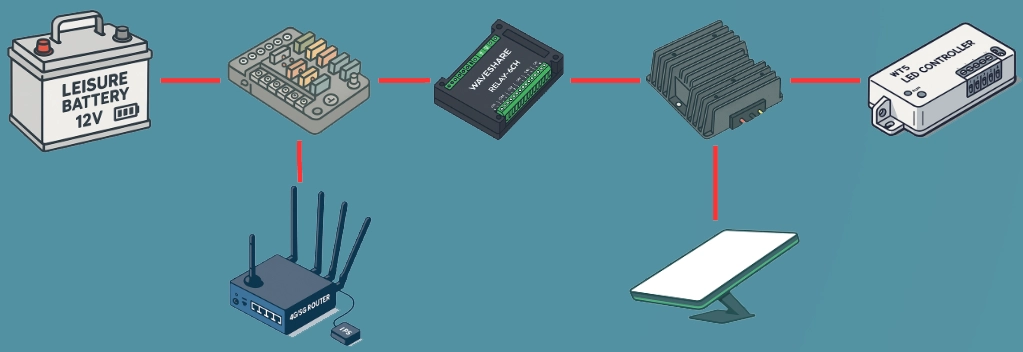

This blog post does not cover your main leisure battery installation, it assumes you have a leisure battery, shunt, maybe an inverter and other items already installed. The assumption is that you already have a fusebox which all your individual items will connect to. Although most of the items for automation will be run from other items, there are a few items we would recommend to still connect directly to your fusebox.
Maybe you want to connect your fridge to a relay so that you can remotely control it, but we prefer it just be connected directly to the fusebox. When you are testing and upgrading your automation system (and let’s be honest it will NEVER end), remember your relays will default probably to off. The last thing when on the road is to discover all your food has gone bad because you switched off your power for something and forgot to turn the fridge back on. For this reason ours is on permanently unless we throw the master power switch to turn the whole van off for maintenance or some other reason. If you need to isolate it individually for maintenance reasons, you can always pull out the fuse for the item.
Your Router power will almost certainly not be controlled by automation. Imagine after turning on your main power if the relay is off how can you connect to it to turn it on if your wireless or switch part of the router has no power. Definitely a chicken-and-egg situation. For this reason our recommendation is to again have it wired directly into the fusebox. If you need to isolate it individually for maintenance reasons, you can always pull out the fuse for the item.
The fusebox is a hub for all automation goodness, most things go back to it in one way or another. You may also have multiple fuseboxes, we have 6 for various different reasons. We have multiple fuseboxes on each side of the van. Remember to fuse each connection correctly and carry spares!
A 5V power hub is almost a must. Many of the automation controllers we use can be powered via 5V USB. We use the Waveshare 5V USB hubs as they are industrial-grade and cater for temperature ranges of -40C to 75C. This is a common theme through many of these blog posts that we use more expensive industrial products as an alternative to cheaper hobby products. Industrial-grade units tend to work in wider temperature ranges (especially below 0C) and are better quality and have more features, e.g. power surge protection. Again depending upon your chosen sensors and power needs, you may have multiple USB power hubs. Again we have 2, one on each side of the van.
Relays will be the heart of your van automation. Other than a few key items, typically they will control the power to most products. Again we use the Waveshare ESP32 6 channel relays for a great industrial-grade product. Each unit will have six wires from the fusebox to power Relay one through to six. Each product needing control will then take its power from the relay. Relays often have a normally open and a normally closed terminal to allow you to decide the if you want to supply power when the relay unit is energised or not. Typically for a van build we will use the normally open. This means when the relay unit is rebooted all the products will be off and you will need to turn on anything you need. Again this is why we don’t hook the fridge up to a relay.
A regulated 12V power hub is also probably a must. Often there are products which cannot handle the varying 12V-14V power of a lithium battery, this includes computers, roof fans and others.
A 24V power hub is optional, but we find them very useful for LEDstrip controllers. Often LEDs run off 24V power. Once again we have multiple 12V to 24V converters, almost one per LEDstrip. At first these seems overkill, but we want redundancy and the ability to turn off completely a light without having to leave the power supply on because it powers multiple LEDs.
A 48V power hub is optional. Typically items such as Starlink and also some PoE switches can use 48V. We have 1 which is used by both of these items.
Other 12V products which do not need a regulated 12V supply. Often devices will accept a range of Volts. e.g. my router takes 7-14V because it is a automotive-grade router. If in doubt check the instructions for your product and look for a detailed specification. These will typically include the power input.
This post aims at introducing some of the various power supplies your van automation needs and we will go into further depth in future blog posts. When planning your power network, we strongly recommend treating the van as two halves. It is very unusual to only have automation on one side, so plan to have one fusebox on each side and potentially one relay and some of the converters on each side.